Morocco was the trip where the scenery kept changing faster than we could get used to it. Over the last days of December we went from the Atlantic in Casablanca to the blue lanes of the Rif, into the medina of Fes, over the Middle Atlas, out to the Sahara for Christmas, back across the High Atlas in snow, and finally into Marrakech. There were four of us, a seven-seater with a driver, a lot of road, and very little that looked the same two days running.
This is the whole loop, roughly in the order we did it, with the bits we would tell a friend before they go.
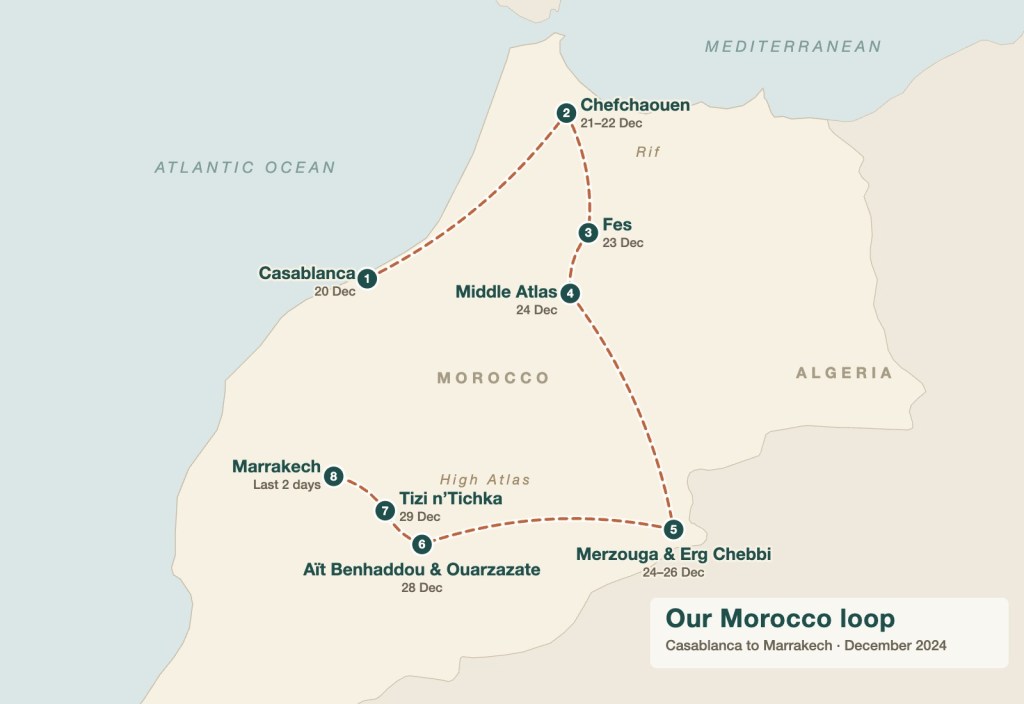
The route
| Dates | Where | What |
|---|---|---|
| 20 Dec | Casablanca | Hassan II Mosque, the Atlantic |
| 21–22 Dec | Chefchaouen | The blue town in the Rif mountains |
| 23 Dec | Fes | The old medina, souks and a madrasa |
| 24 Dec | Middle Atlas → Merzouga | Barbary macaques, then the long drive south |
| 24–26 Dec | Merzouga and Erg Chebbi | Christmas in the Sahara, and a night in a desert camp |
| 28 Dec | Aït Benhaddou and Ouarzazate | The ksar and the film studios |
| 29 Dec | Tizi n’Tichka | Snow on the High Atlas pass |
| Last 2 days | Marrakech | Two days in the souks around Jemaa el-Fnaa |
Casablanca, and a mosque on the sea
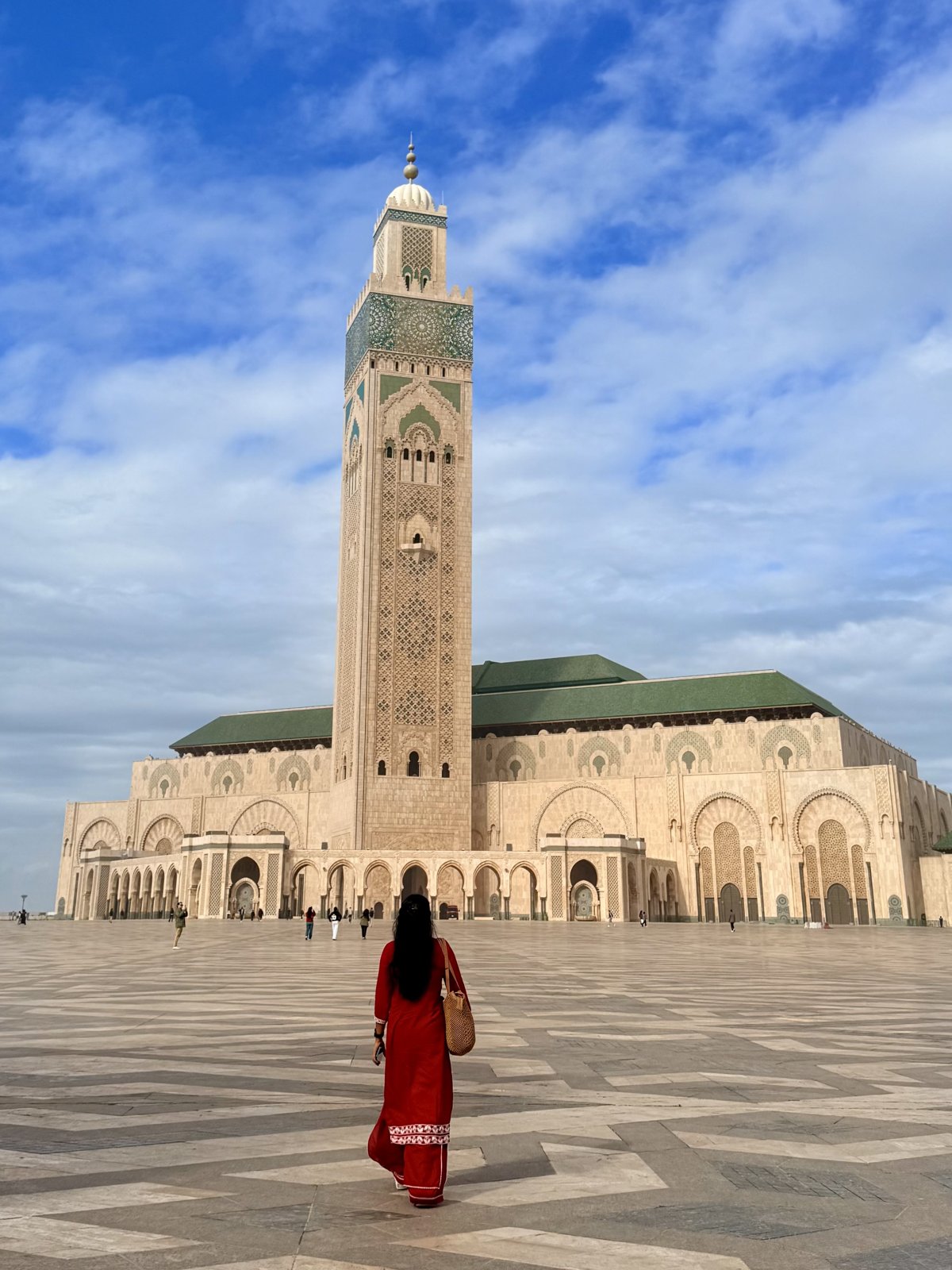
We started in Casablanca, and most people will tell you Casablanca is a city to fly into and leave. That is mostly fair, with one large exception. The Hassan II Mosque sits right on the edge of the Atlantic, part of it built out over the water, and its minaret is one of the tallest in the world. Up close the scale is hard to take in: the tilework, the carved cedar, the sheer width of the plaza. It is also one of the few mosques in Morocco that non-Muslims can go inside, on a guided tour.
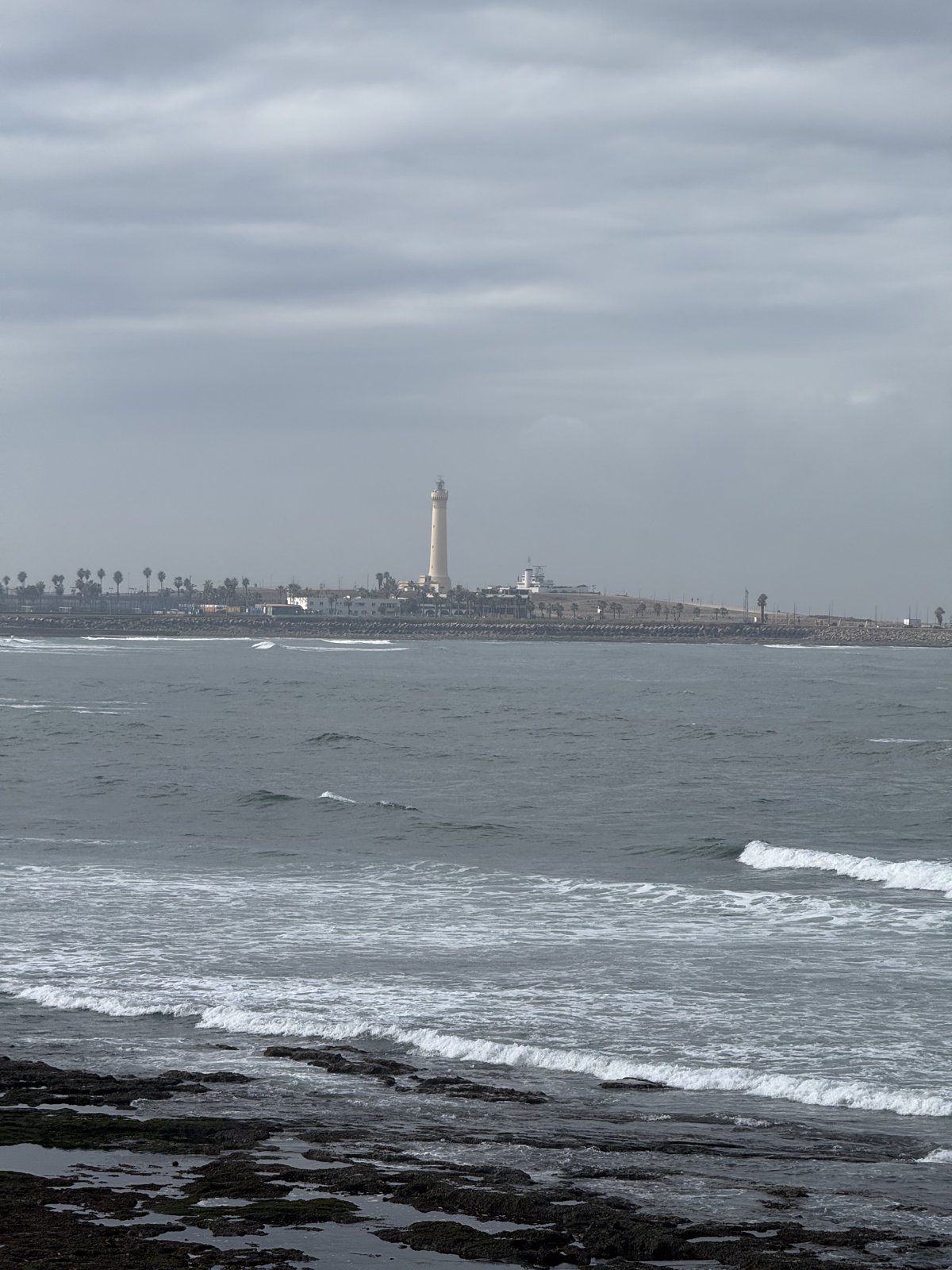
Walk round the back of the mosque to the sea wall. In December the Atlantic was grey and loud, which felt like a good way to start a trip that would end up in a desert.
Chefchaouen, the blue town
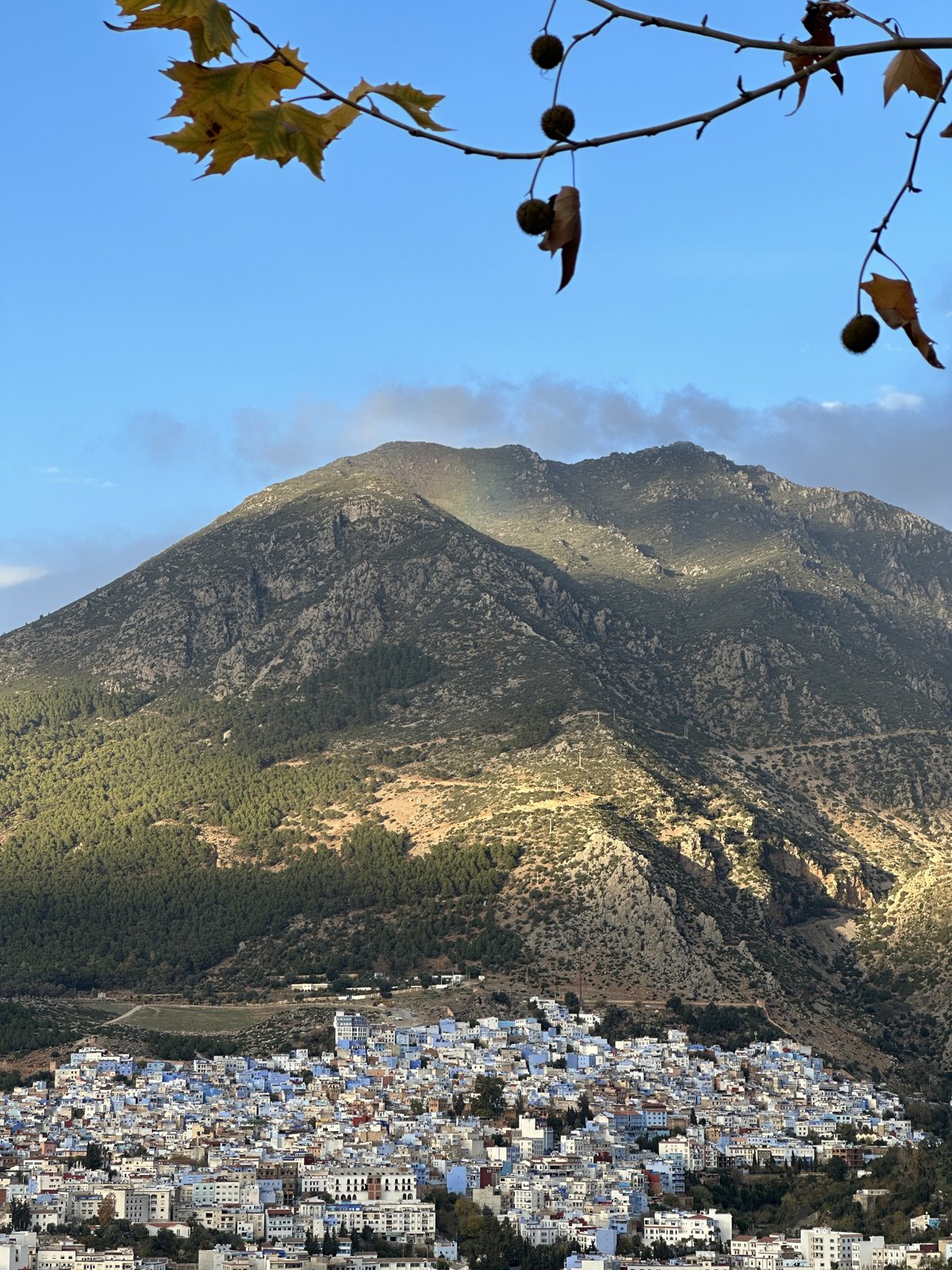
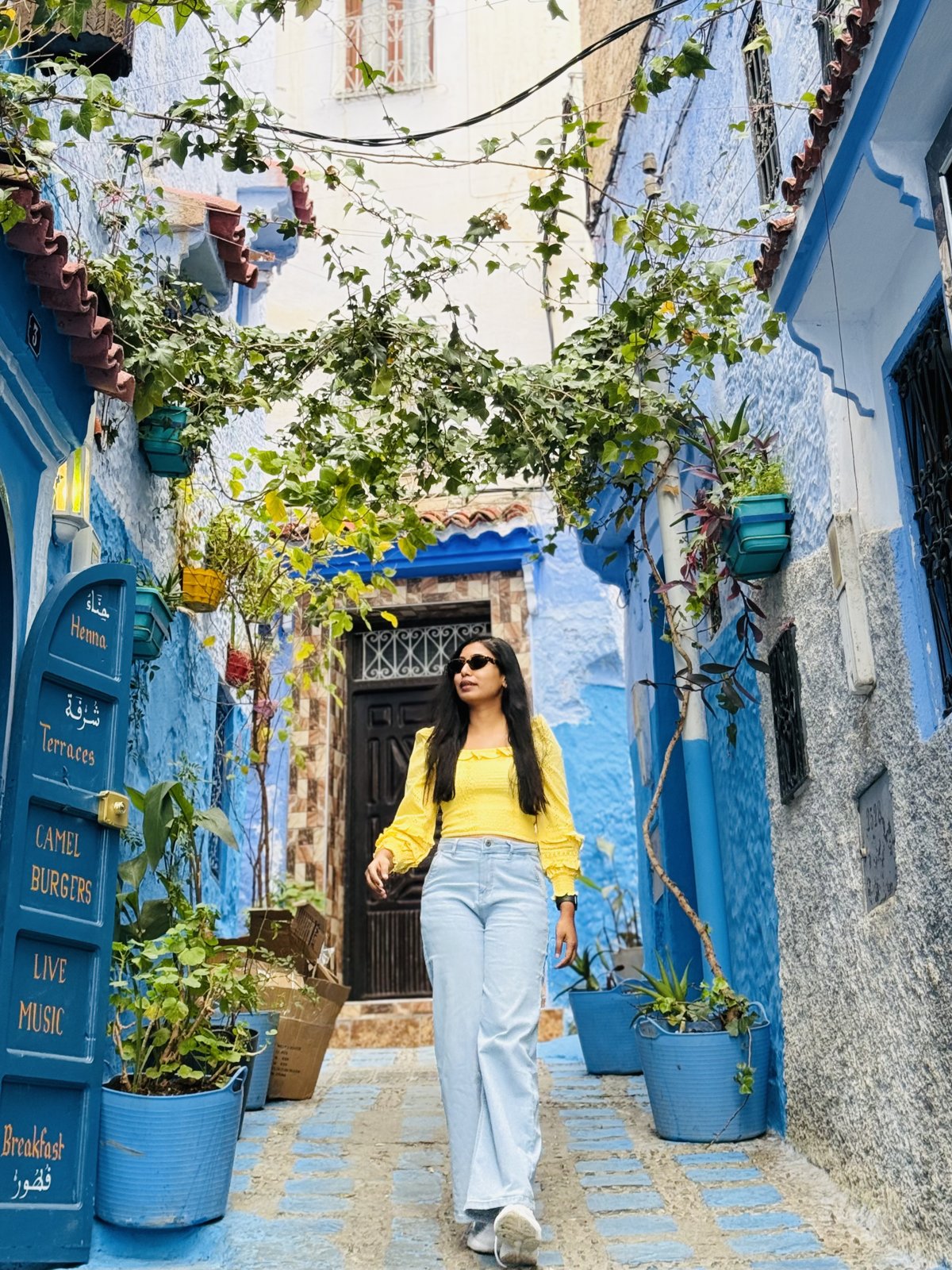
Chefchaouen sits in the Rif mountains in the north, and from above it looks like someone spilt a tin of blue paint down the hillside. Up close it is a maze of stepped lanes washed in every shade of blue, with potted plants on the steps and doors in colours that do not quite match.
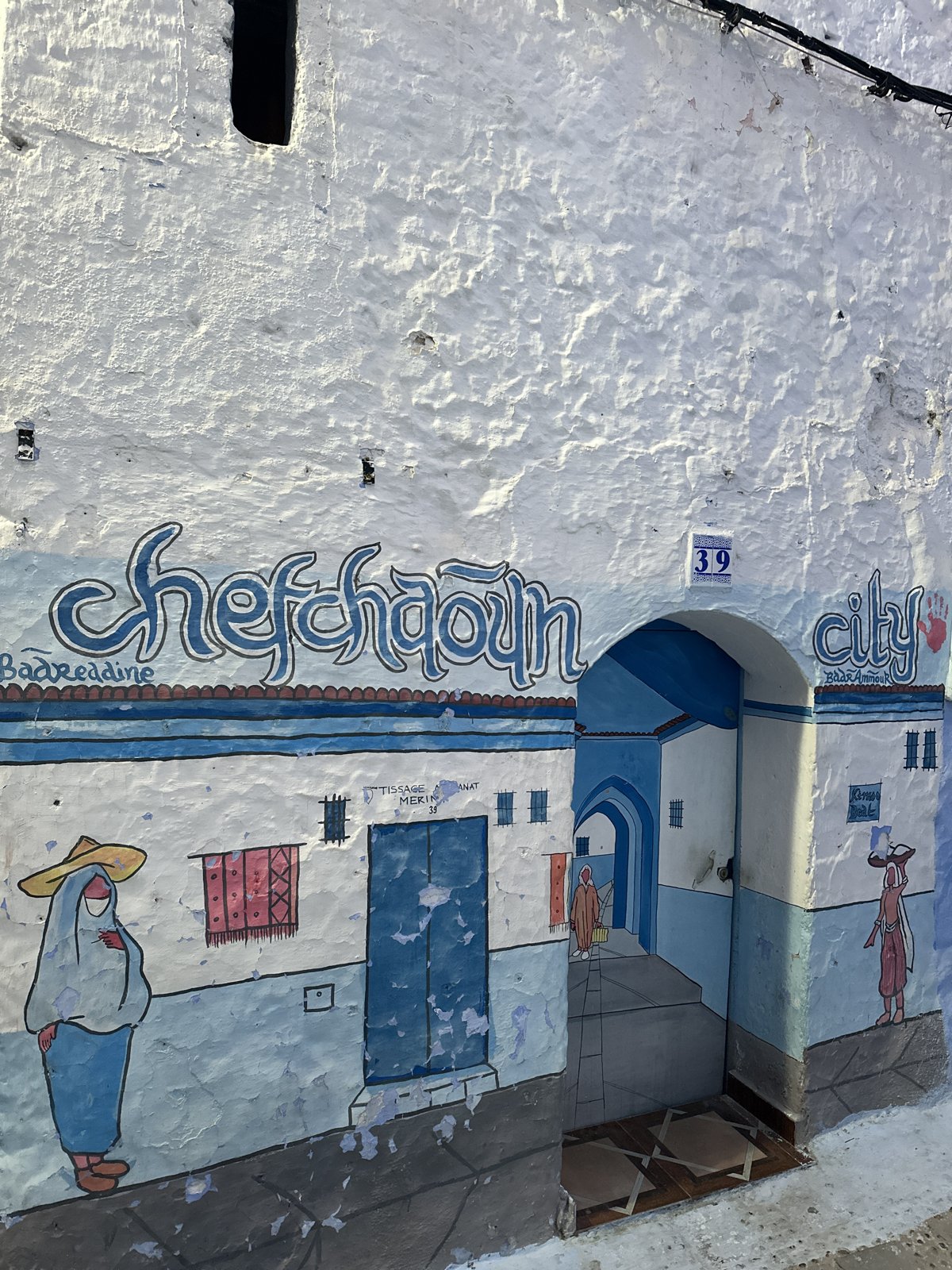
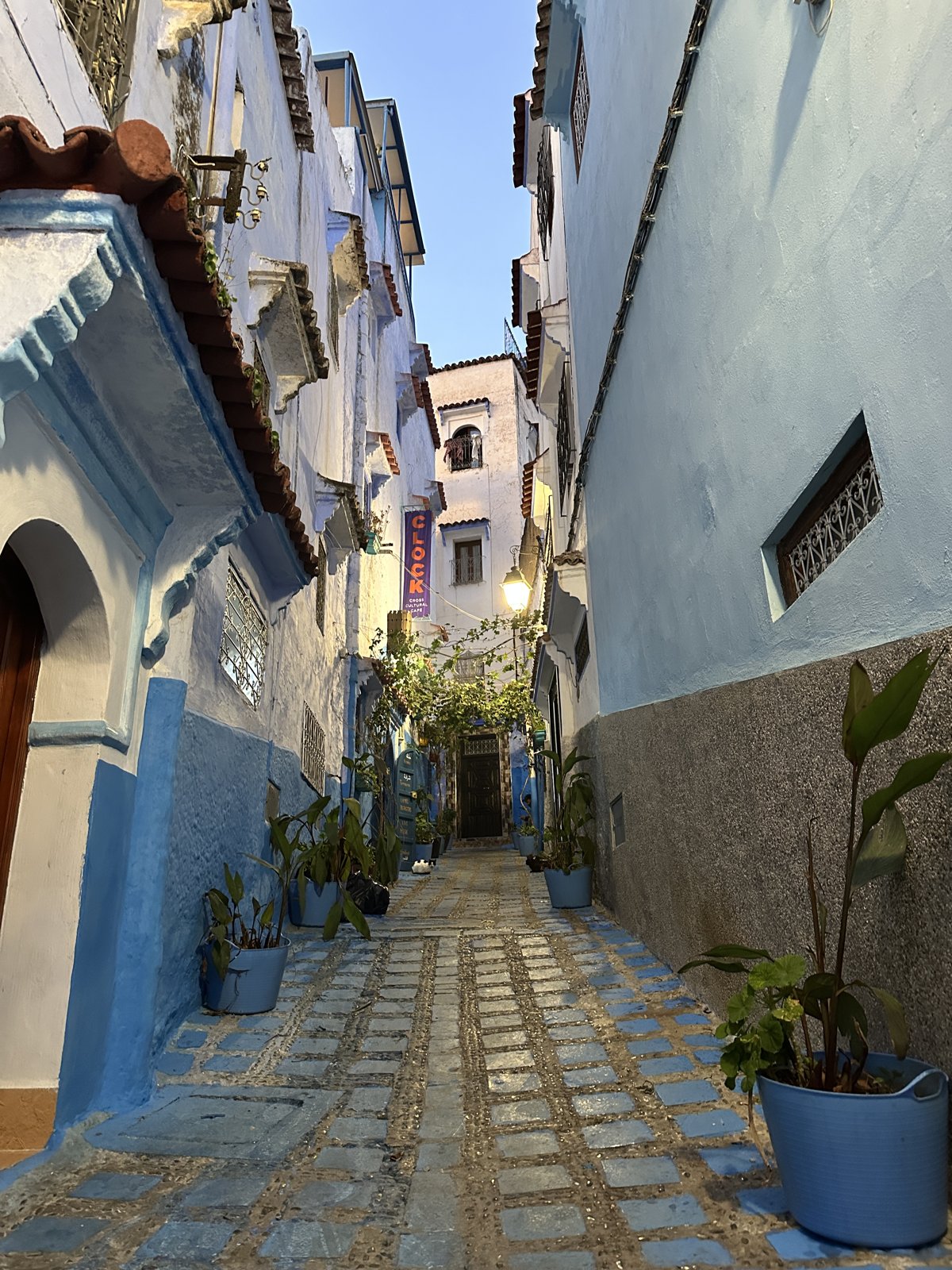
It is touristy, there is no getting round it, and the most photogenic corners have a small queue of people waiting their turn. Go early in the morning, before the day-trippers arrive, and it is a different, much quieter town.
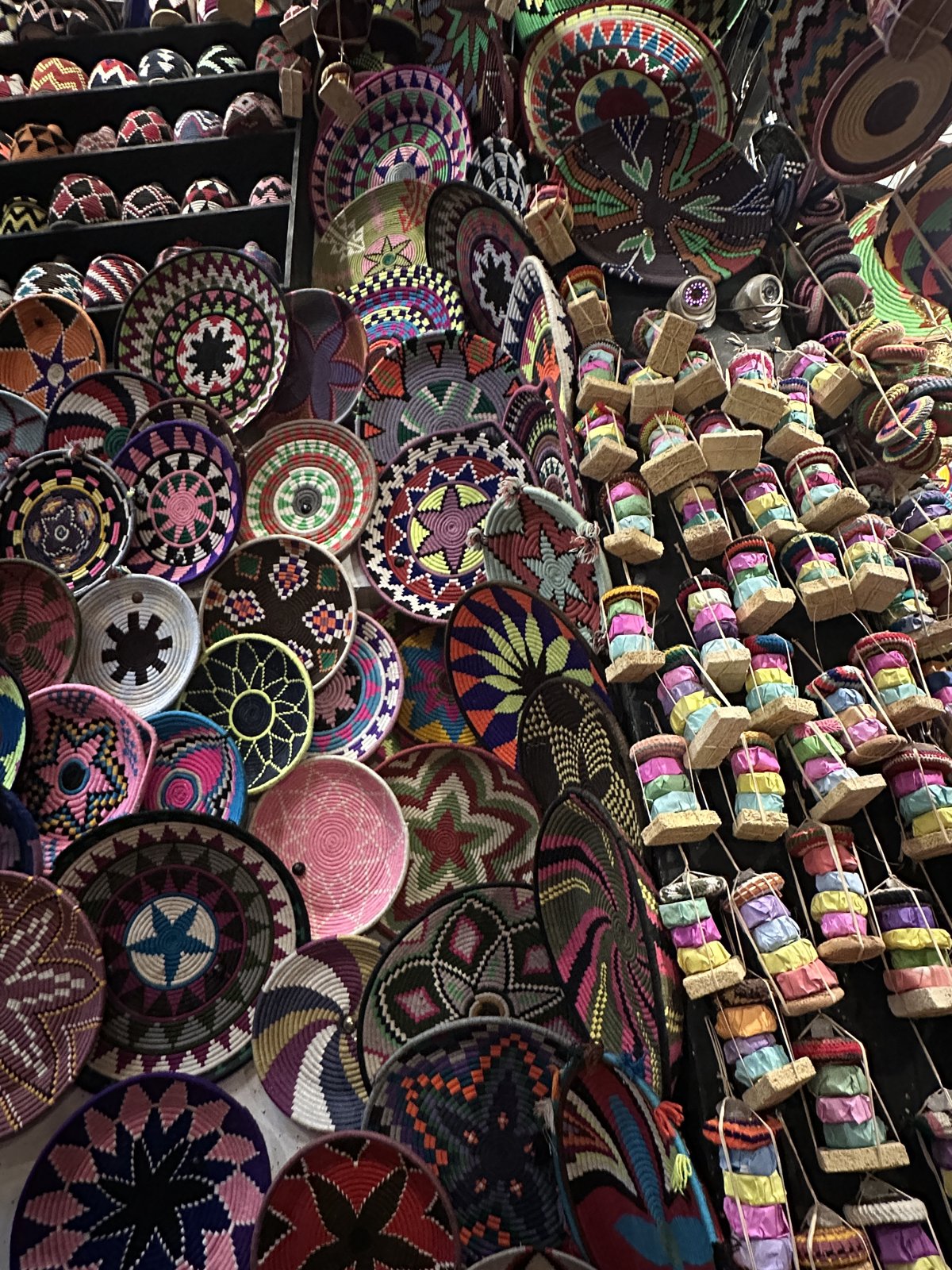
In the evening the souk lights up and the shops spill out onto the steps: woven baskets, wool blankets, painted plates and little leather slippers in every colour.
Fes, and the oldest medina
From Chefchaouen we went south to Fes. Fes el-Bali, the old walled medina, goes back to the ninth century and is one of the largest car-free urban areas in the world: thousands of lanes, many barely shoulder-width, with donkeys still doing the deliveries. It is a UNESCO World Heritage Site, and it does not feel like a museum. People live and work in it.
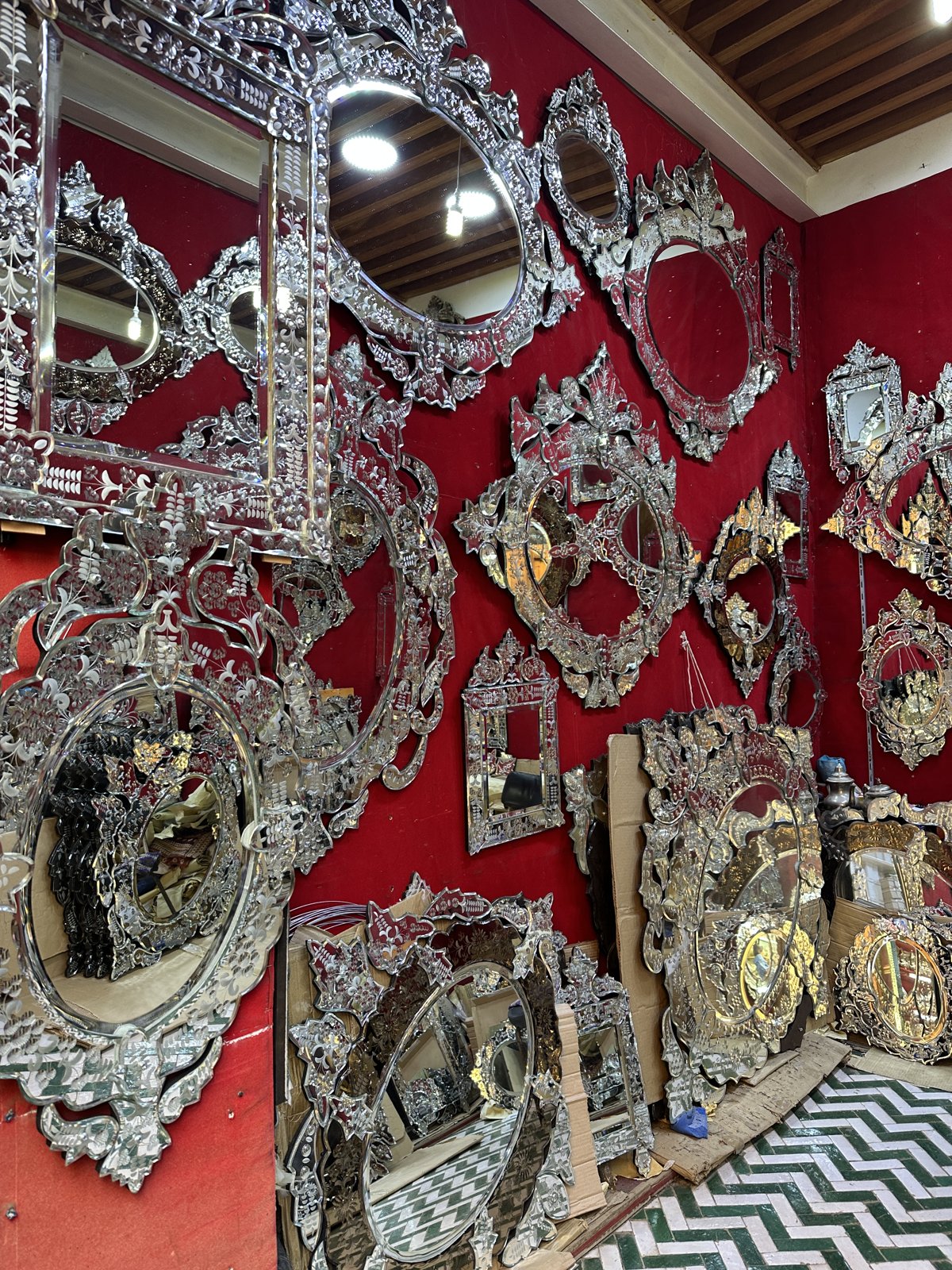
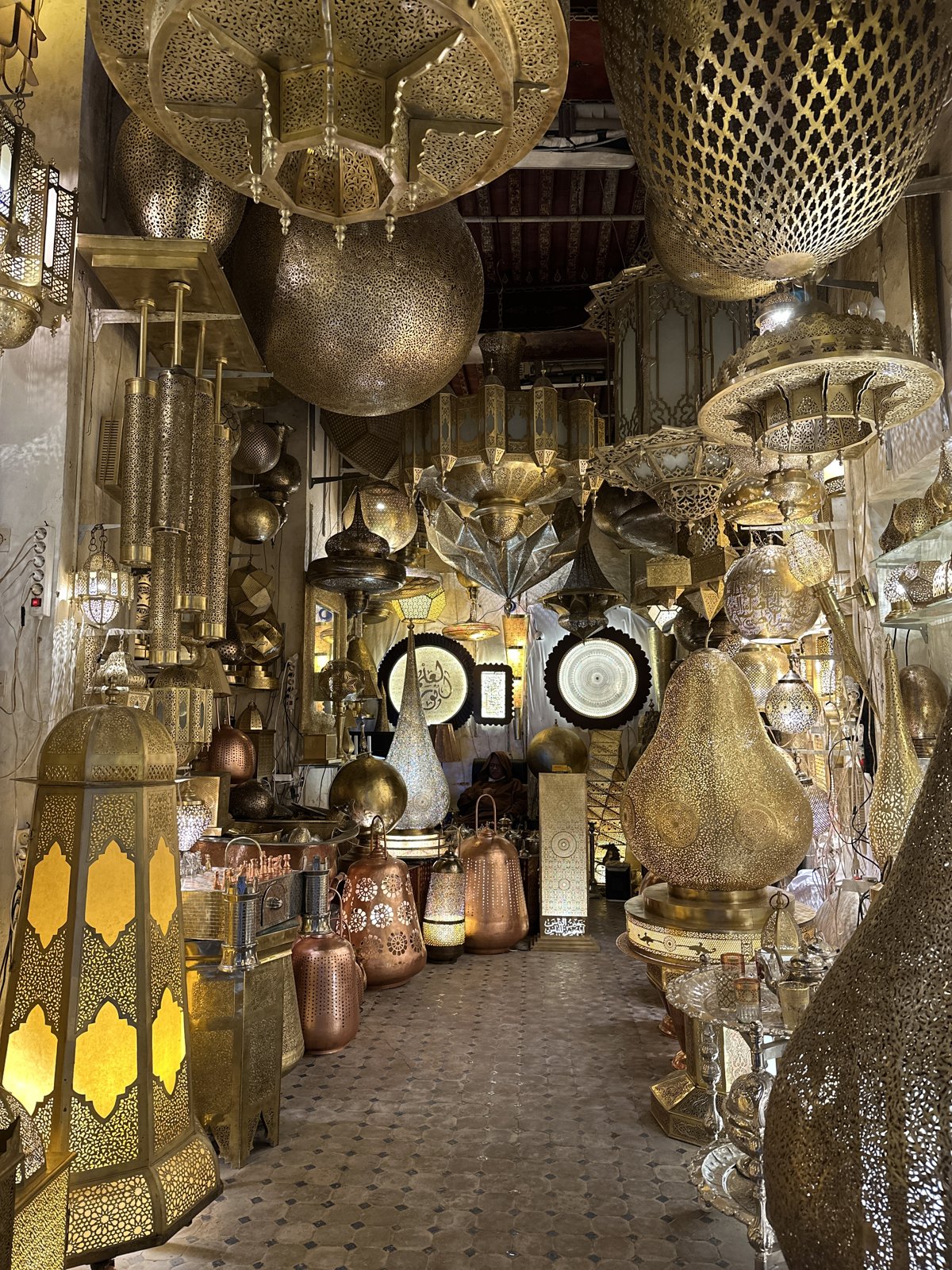
The souks are organised roughly by trade, so you walk from a lane of leather into a lane of brass into a lane of spices. Every shop is a small cave of things, and the craftsmanship is real: hammered metal, carved wood, mirrors framed by hand.
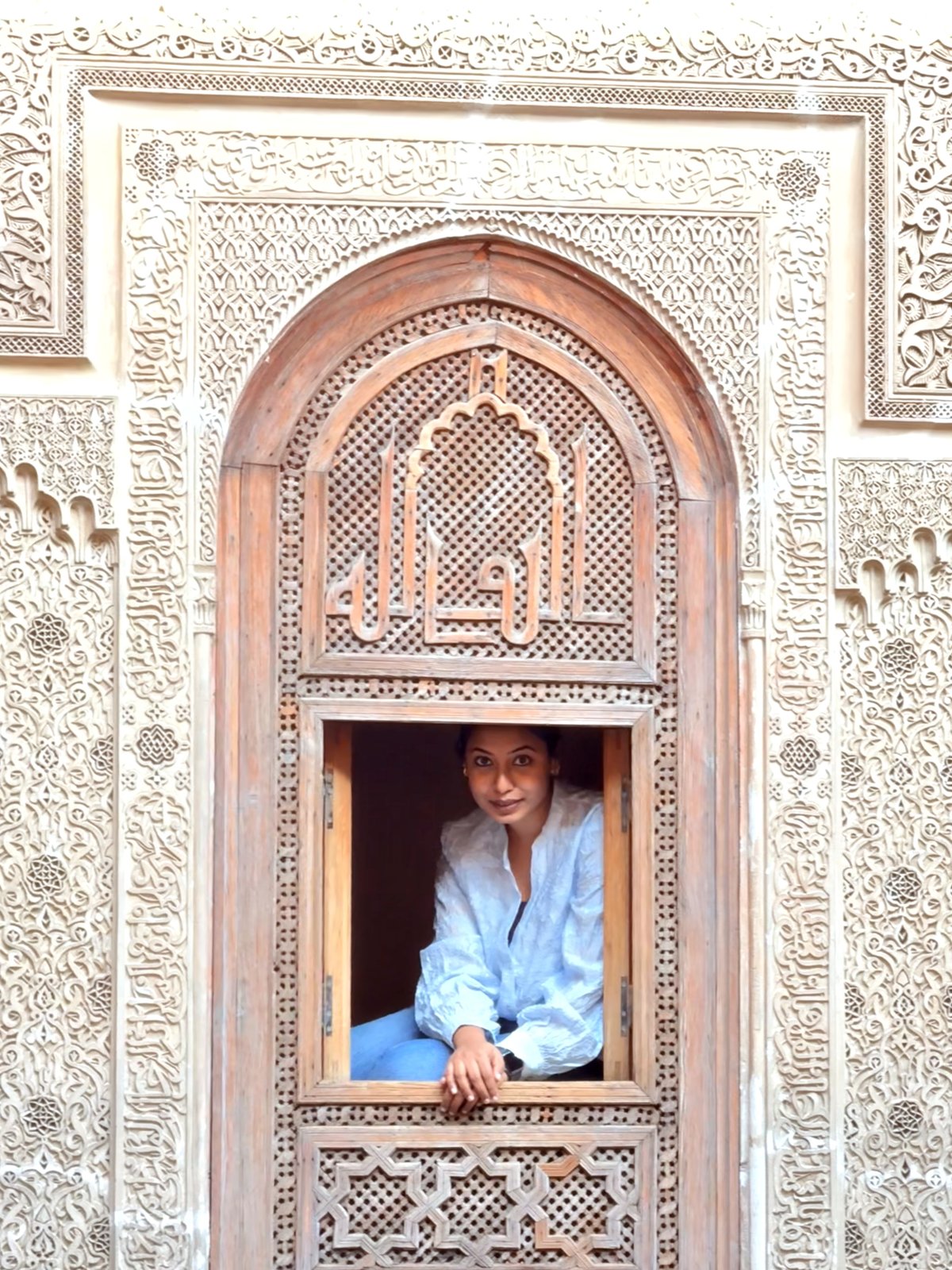
The real treasures are the old Koranic schools, the madrasas, with their courtyards of zellige tiles, carved stucco and cedar. Everything is carved, every surface, and somehow none of it feels cluttered.
One tip: get a local guide for at least part of your first visit. The medina is genuinely hard to navigate, phone maps struggle in the narrow lanes, and a guide will take you to the places you would never find alone.
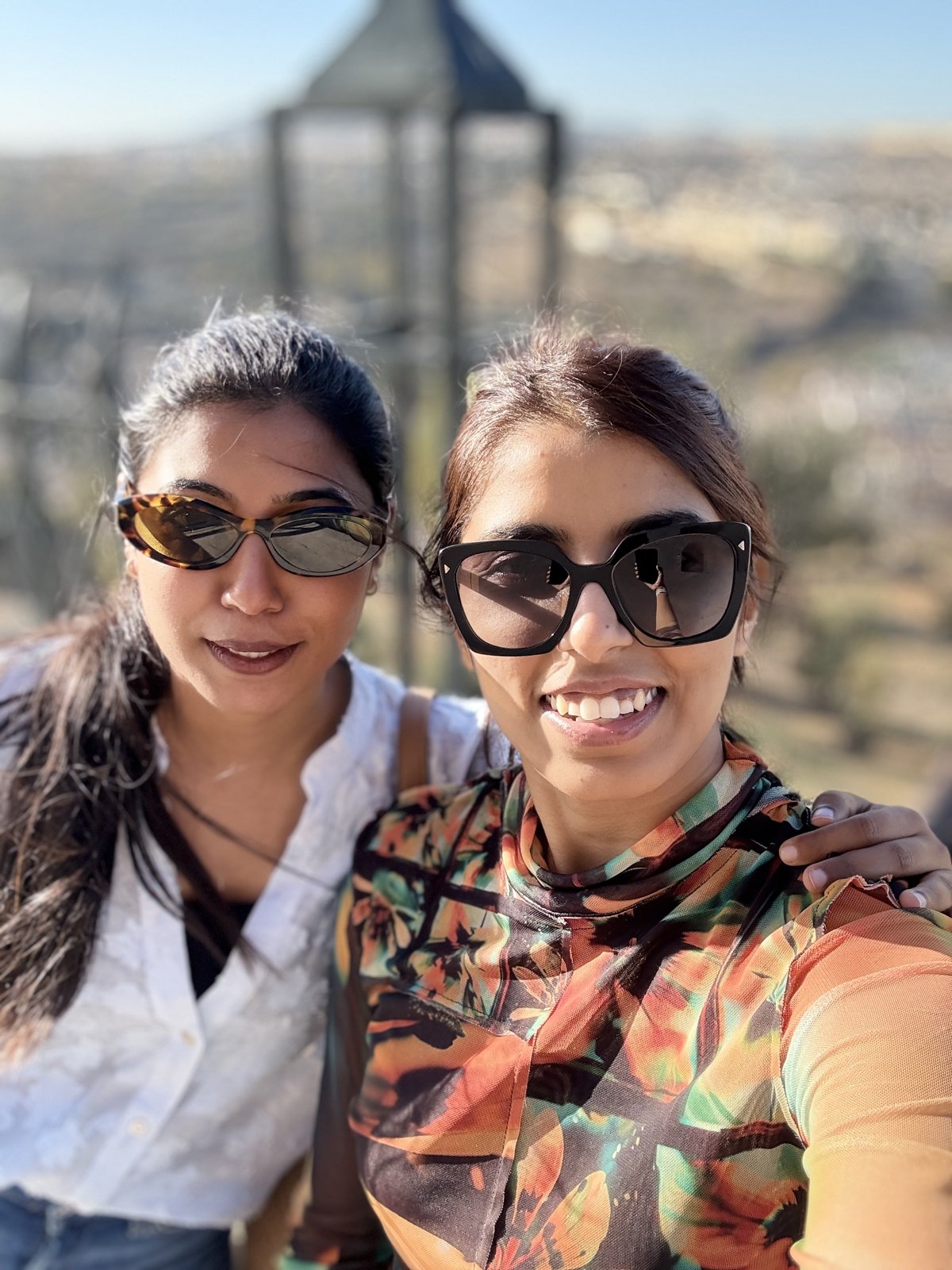
In the late afternoon we climbed up to a viewpoint above the city. From up there the whole medina is a single packed mass of rooftops, and you start to understand why you got lost.
The hammam. Before we left Fes we did a traditional hammam, and it turned out to be one of the highlights of the whole trip. The hammam has been part of daily life in Moroccan cities for centuries, a public bathhouse where people go to steam, scrub and talk, and Fes has some of the oldest.
The ritual is simple and thorough. You start in the steam to warm up, then you are covered in black soap, the olive-based savon beldi, and left to sit in it. Then comes the scrub with a rough kessa glove, which takes off far more skin than you would think you had to spare, followed by buckets of warm water. You come out pink, very clean and completely relaxed.
After days of walking the medina, it was exactly what we needed. If you do one thing in Fes that is not sightseeing, make it this.
Over the Middle Atlas
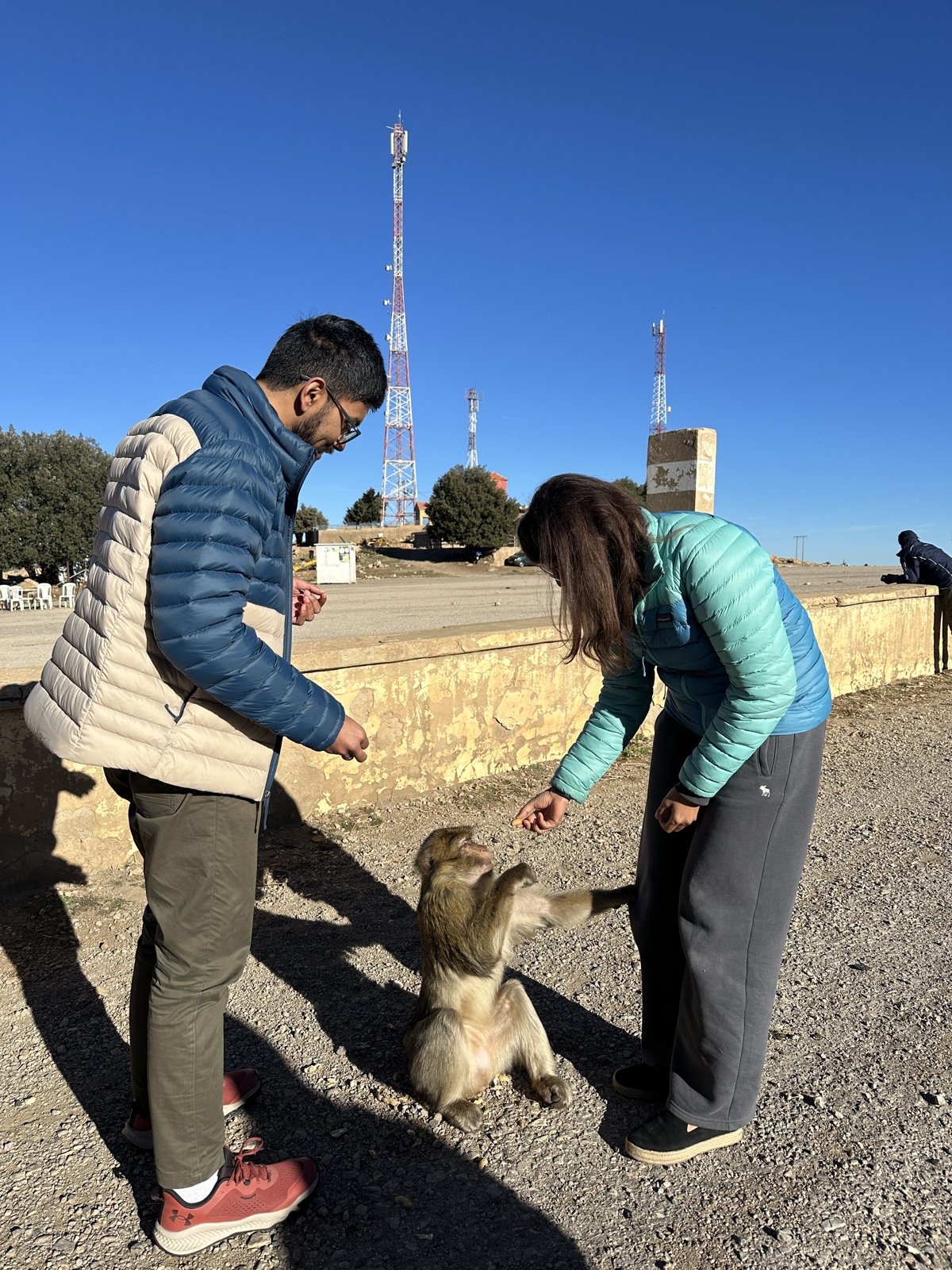
On Christmas Eve we left Fes early and drove south over the Middle Atlas. Up at nearly 1,900 metres, at a roadside stop in the cedar country, we met the Barbary macaques. They are the only macaques found in Africa, they are endangered, and they know exactly what a tourist car means. You are asked not to feed them, which they find very disappointing.
After that the road drops down and the landscape empties: cedar forest, then high bare plateau, then the long red valleys that lead towards the Sahara. It is a long day in the car, so it is worth knowing in advance.
Christmas in the Sahara
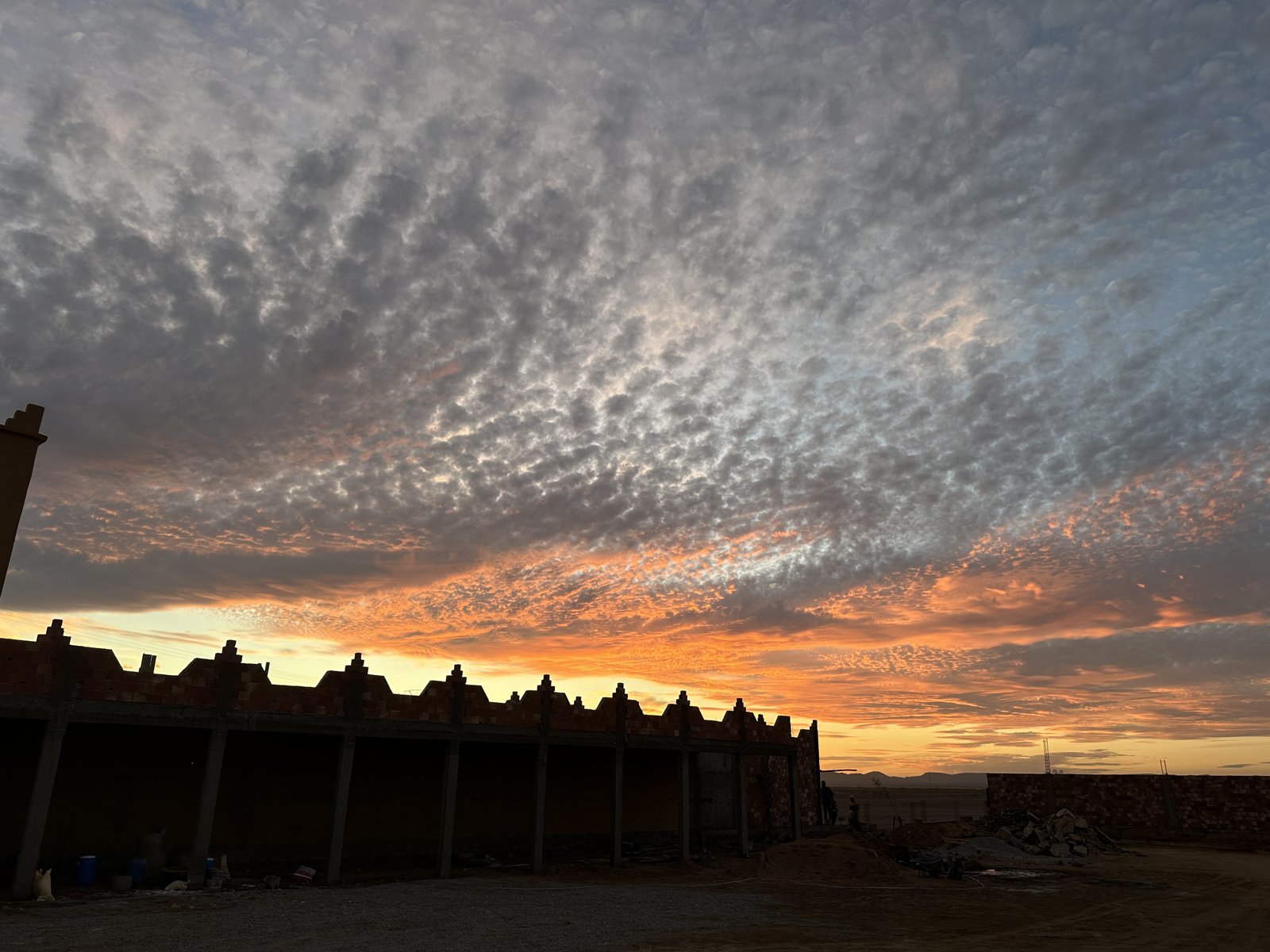
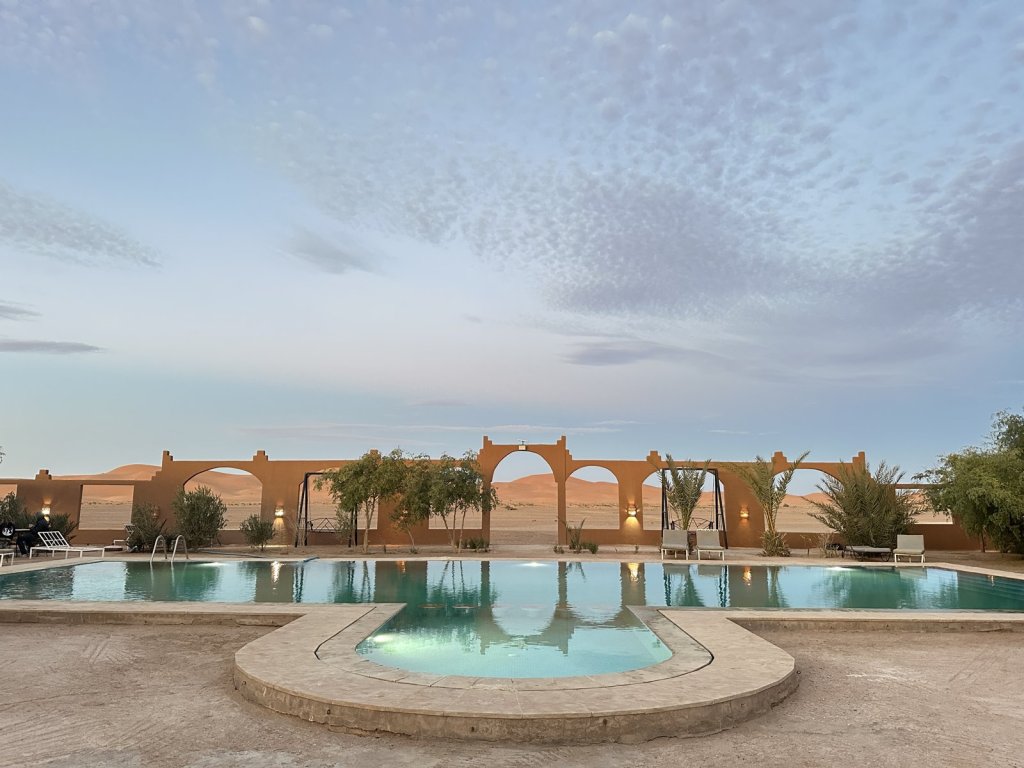
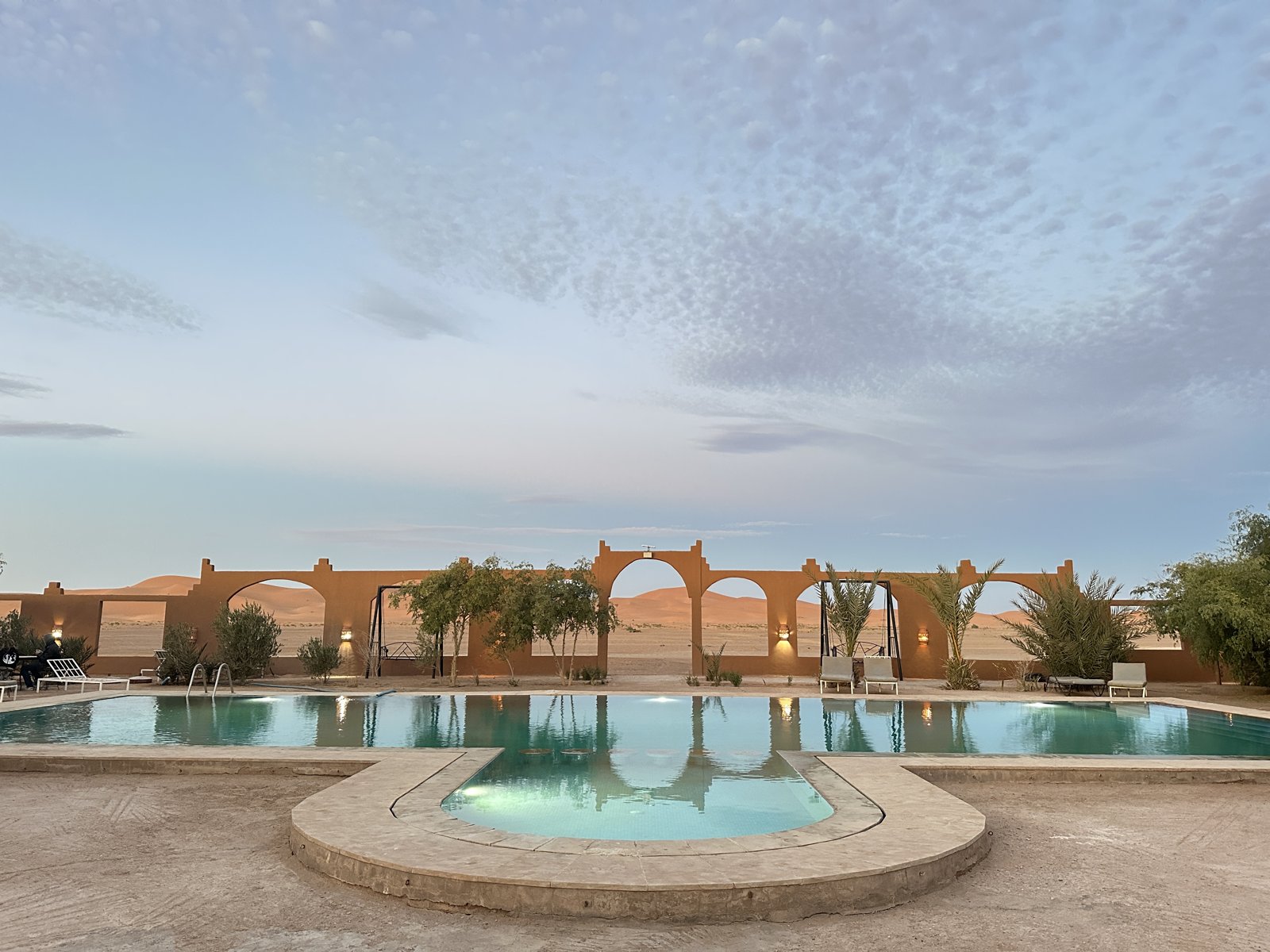
We reached Merzouga, on the edge of the Erg Chebbi dunes, just as the sun went down on Christmas Eve, and the sky put on a show. Our hotel was a kasbah-style place right at the foot of the dunes, with a pool facing the sand and a lounge full of lanterns.
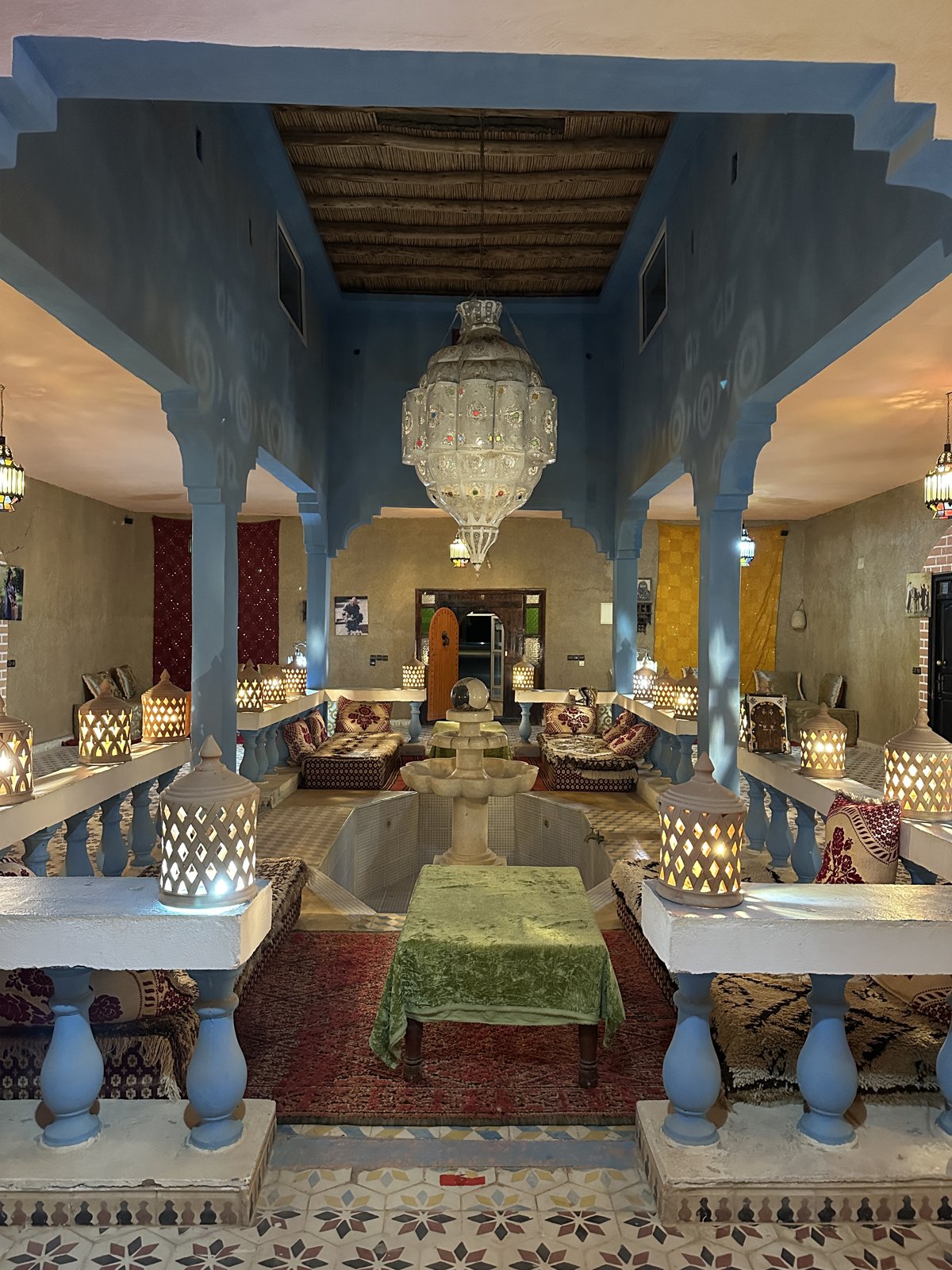
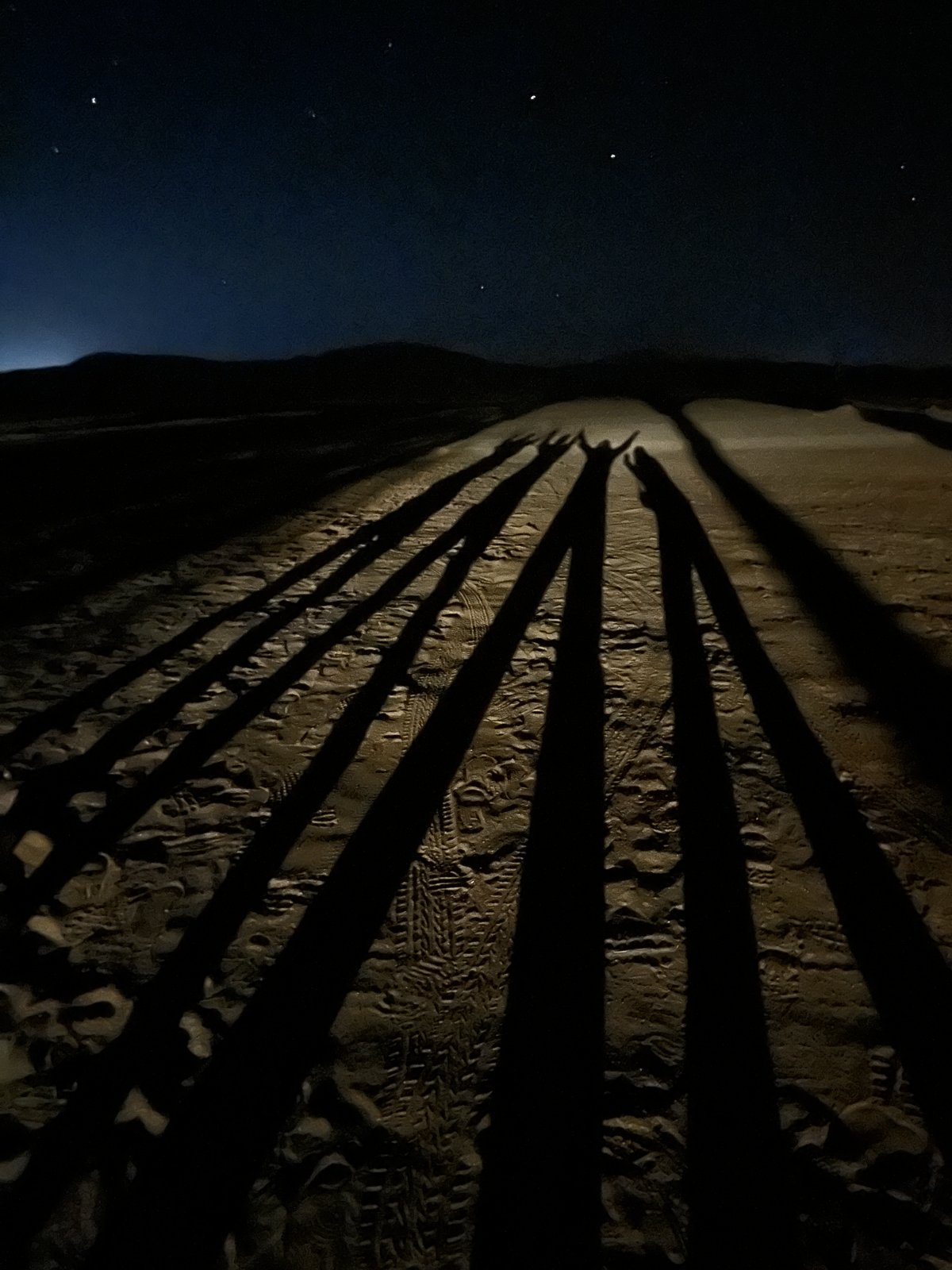
Later that night we walked out onto the sand. There is no light out there except the stars and whatever is behind you, and our shadows stretched all the way up the dune.
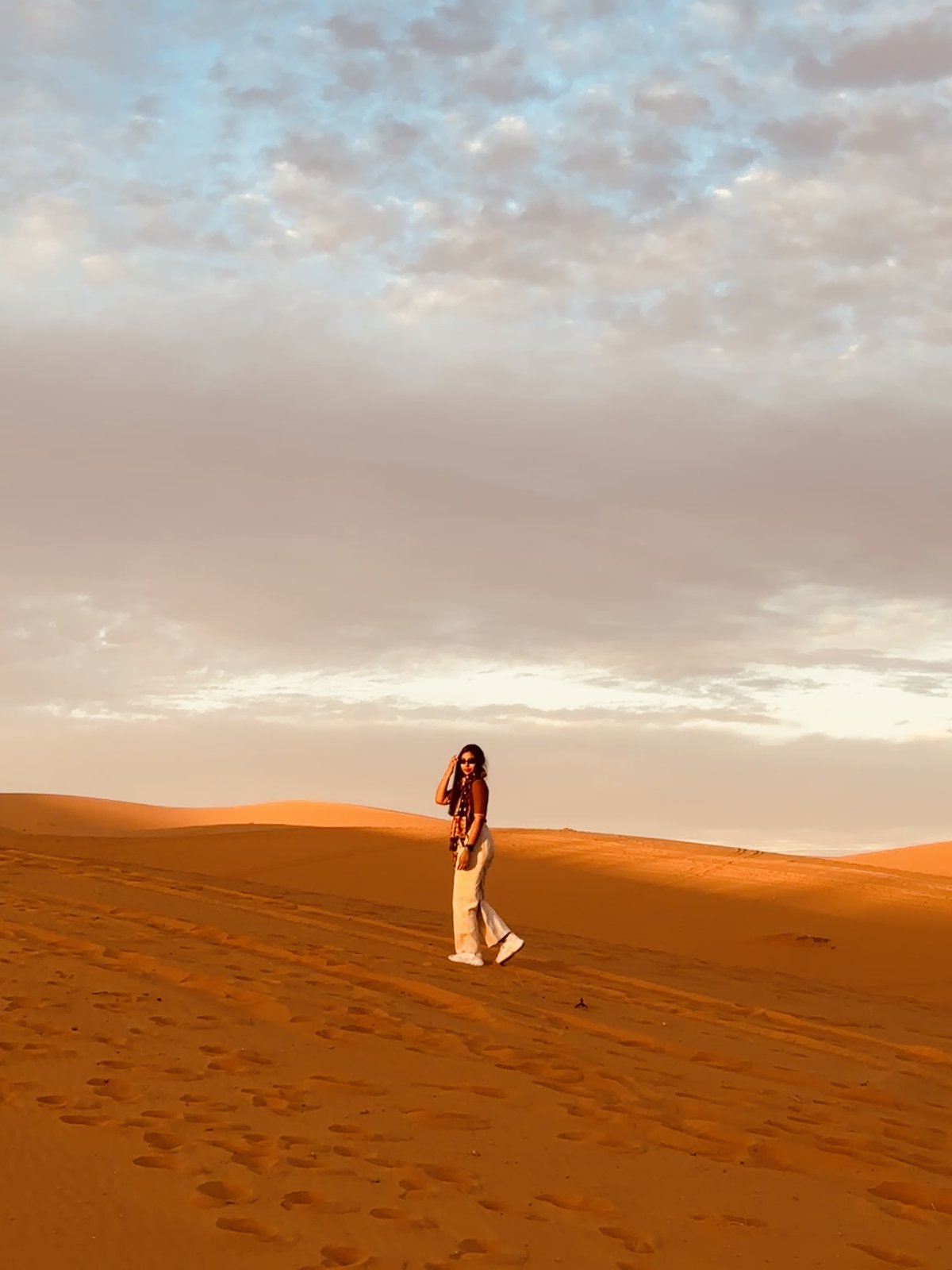
Erg Chebbi is a sea of sand dunes, some of them over 100 metres high, that change colour through the day: pale in the morning, deep orange in the late afternoon. On Christmas Day we went out at sunset and just stood on a ridge watching it happen. It is very quiet, and very big, and that is most of what there is to say about it.
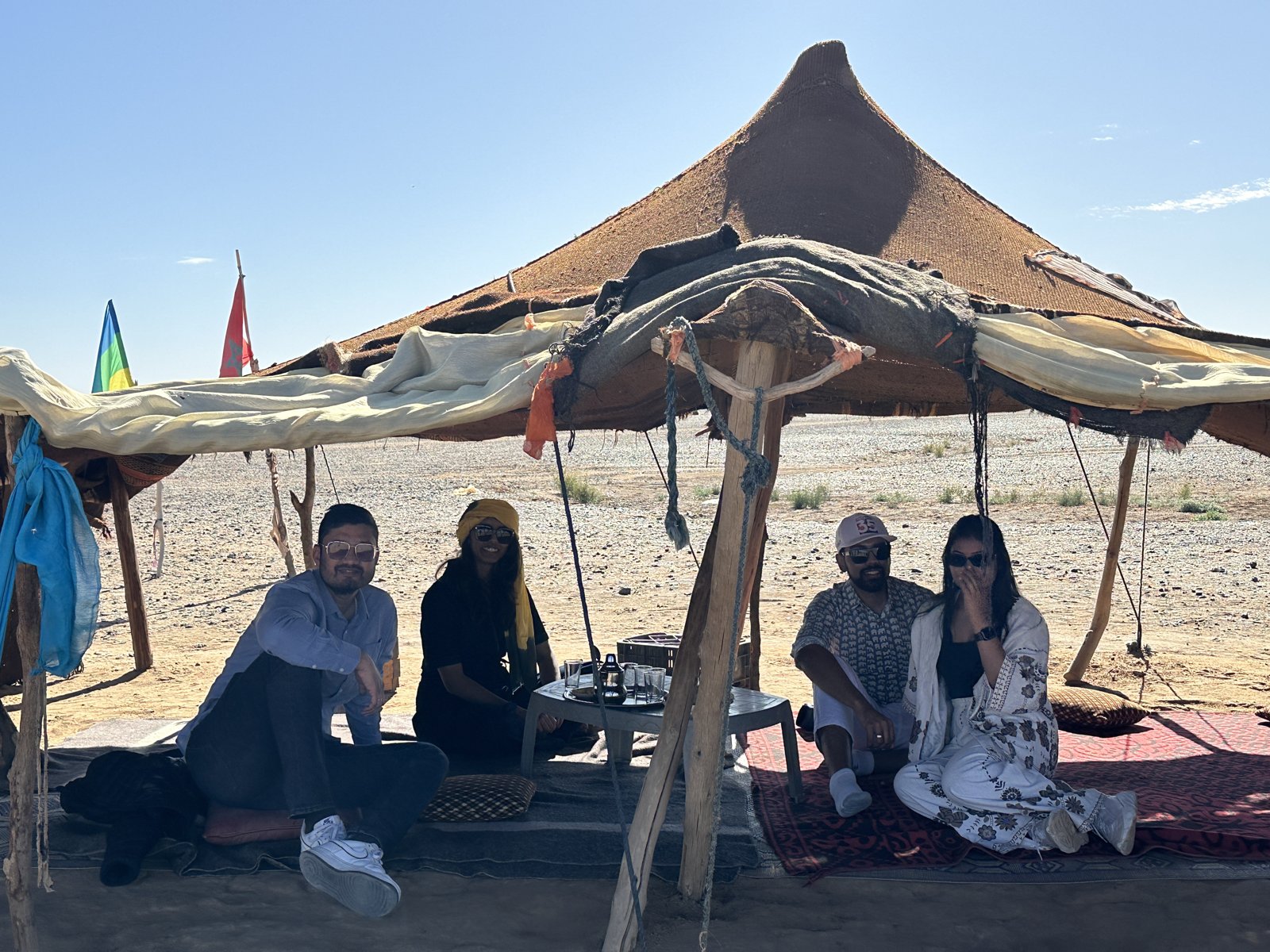
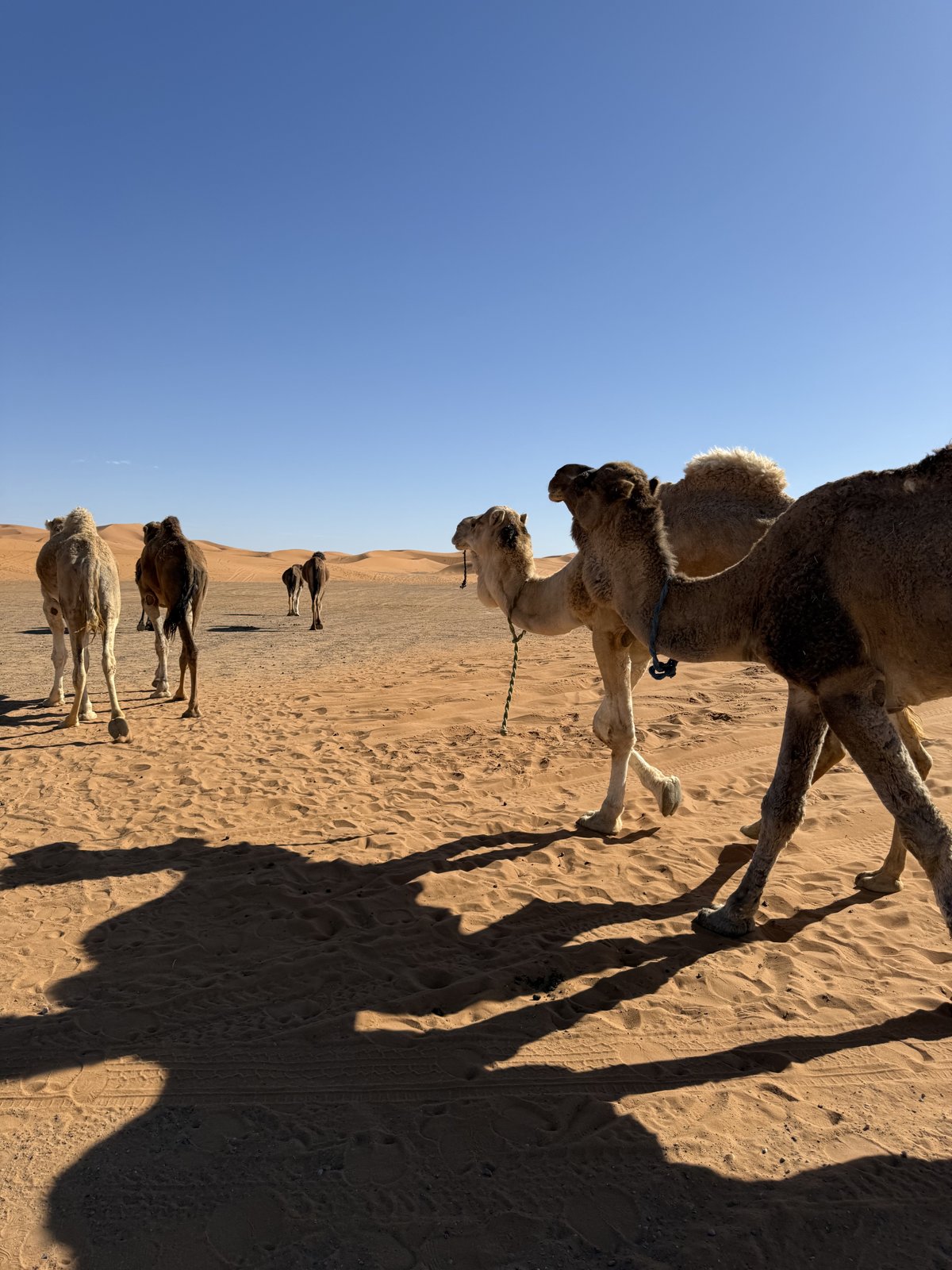
The next day we went out into the desert around the dunes and stopped at a nomad tent for sweet mint tea, sitting on rugs on the sand. Then we went back up the dunes in full sun and did the obligatory jumping photo, which took more attempts than any of us will admit.
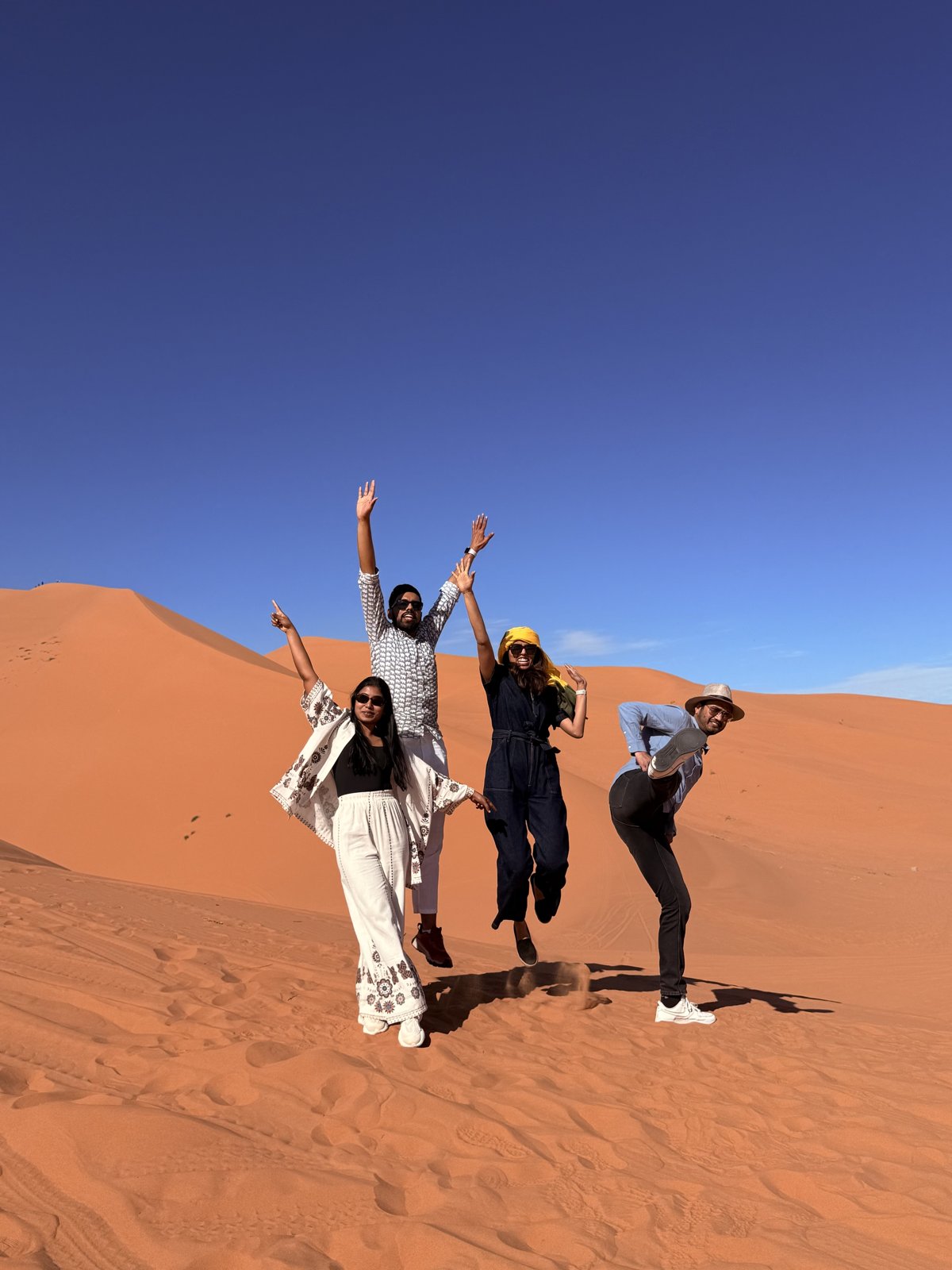
We also spent a night out in the desert itself, in a camp among the dunes. It is cold once the sun goes, properly cold, and on a clear night the stars are extraordinary. If you go to Merzouga, do not just stay on the edge of the sand. Sleep in it for at least one night.
Aït Benhaddou and the film studios
From the desert we headed west on the long road towards Ouarzazate.
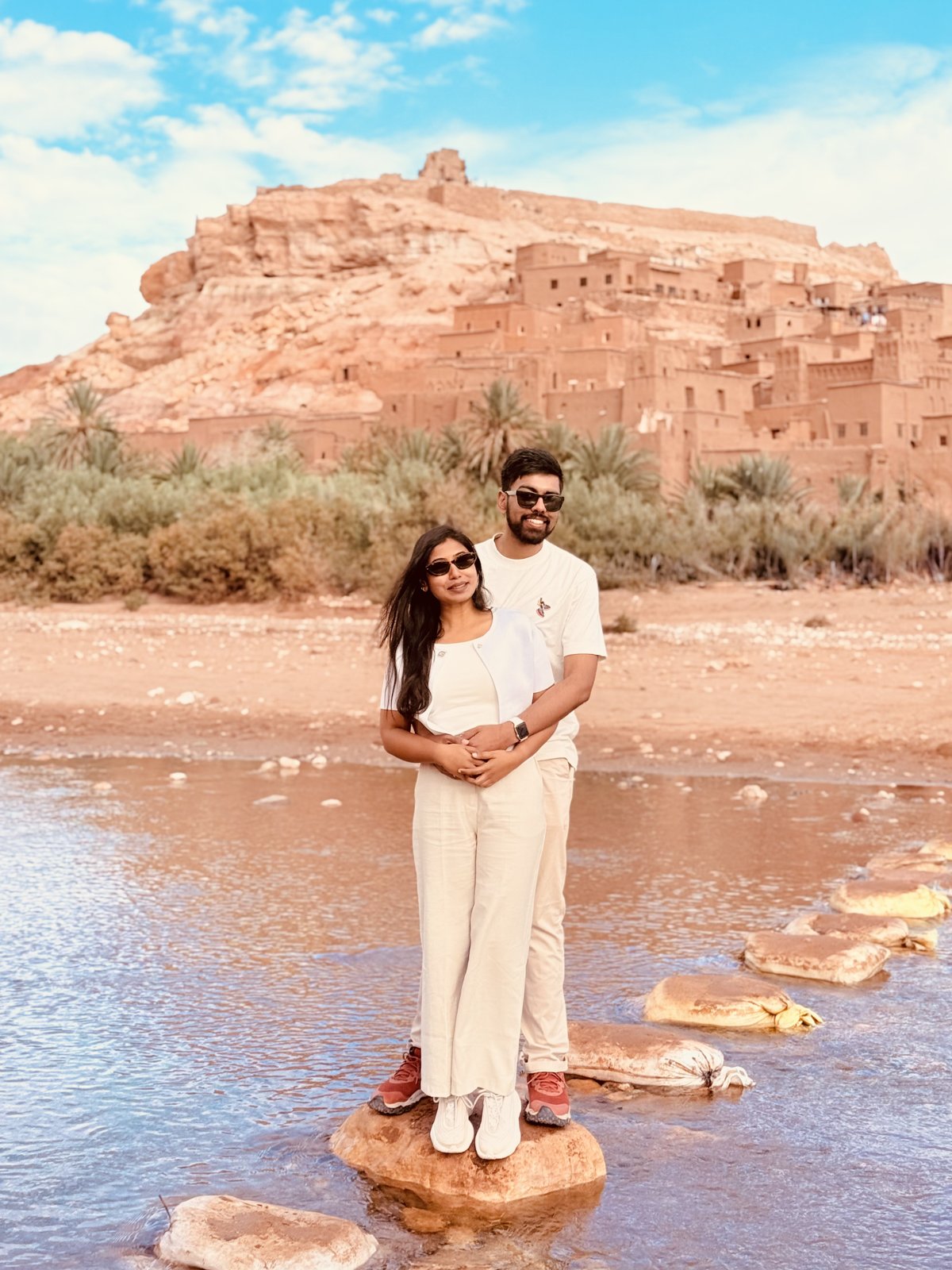
Aït Benhaddou is a ksar, a fortified village of earthen houses stacked up a hillside above the Ounila river, on the old caravan route between the Sahara and Marrakech. It is a UNESCO World Heritage Site, and if it looks familiar, that is because it has been in a lot of films and television, from Gladiator to Game of Thrones. You cross the river on stepping stones, and you can climb up through the lanes to the old granary at the top for the view back over the valley.
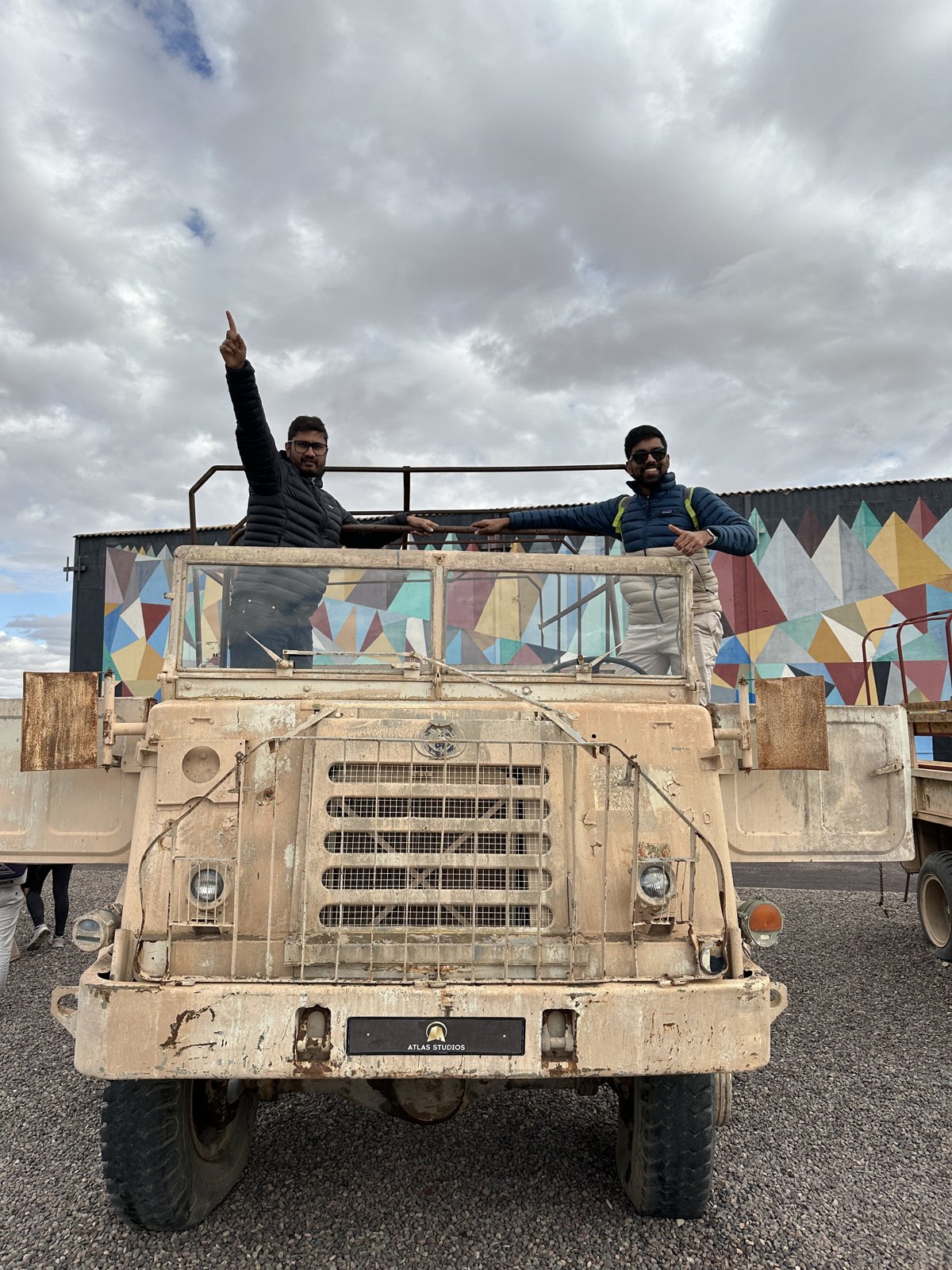
Ouarzazate, just down the road, calls itself the Hollywood of Africa, and has the film studios to prove it. Wandering around a studio lot full of old sets and props is a slightly surreal way to spend an afternoon after the Sahara, but it was a lot of fun.
Snow on the Tizi n’Tichka
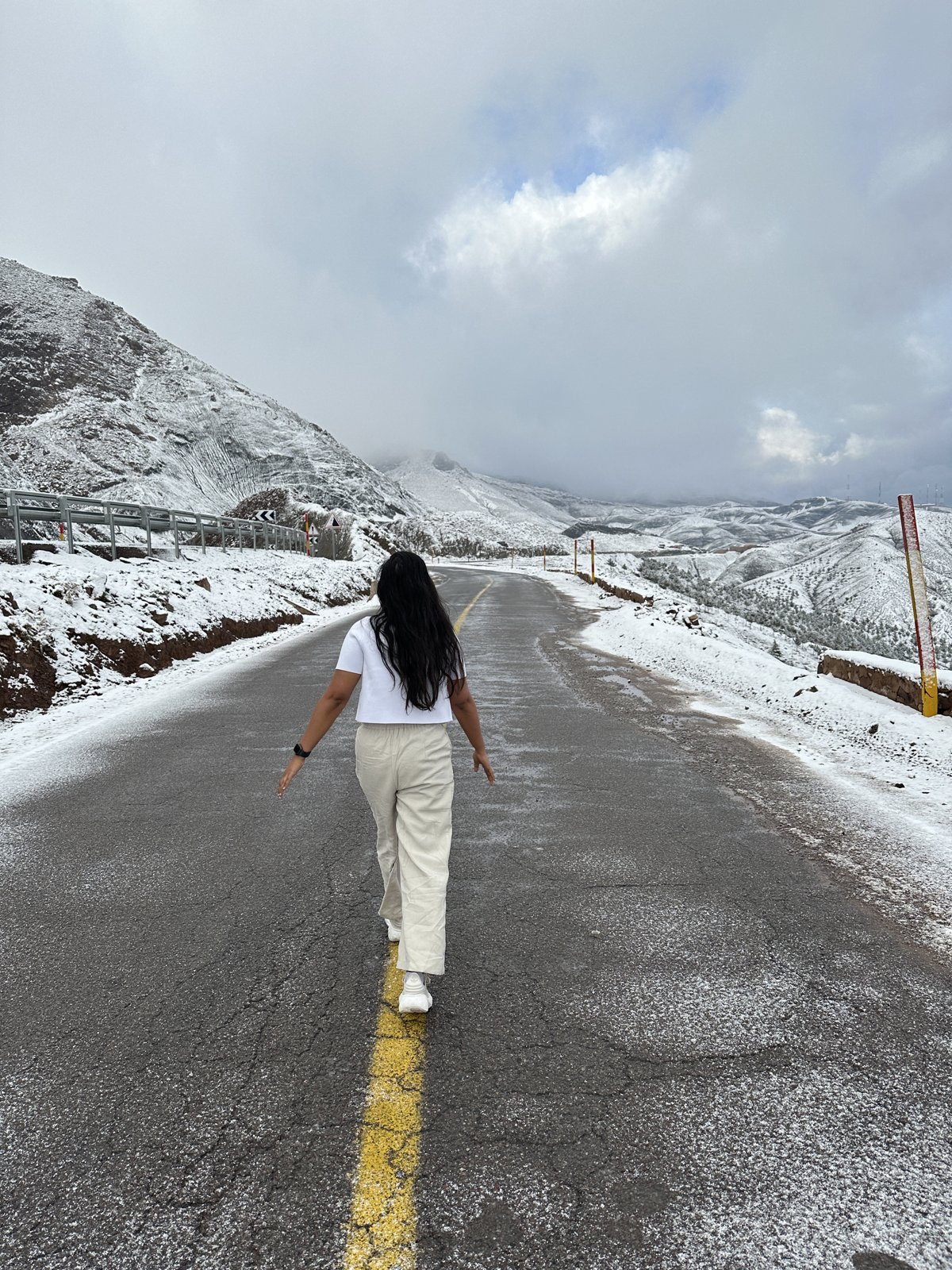
Our last morning on the road was the strangest contrast of the whole trip. The road from Ouarzazate to Marrakech crosses the High Atlas over the Tizi n’Tichka pass, at about 2,260 metres, and there was snow on both sides of the road. Four days after standing on warm sand dunes, we were walking down a mountain road between snowbanks.
The pass is a beautiful drive, all switchbacks and red mountainsides, but in winter it can close or slow right down because of snow. Check the conditions before you set out, and do not plan anything tight at the other end.
Ending in Marrakech
The road down from the pass brought us into Marrakech, and we finished the trip with two days there, ending where a lot of Morocco trips begin. After all those mountains and desert, the souks around Jemaa el-Fnaa felt like a different country again: lanes of carpets, lanterns, ceramics and silver, every shop stacked to the ceiling, and a lot of mint tea while you make up your mind.
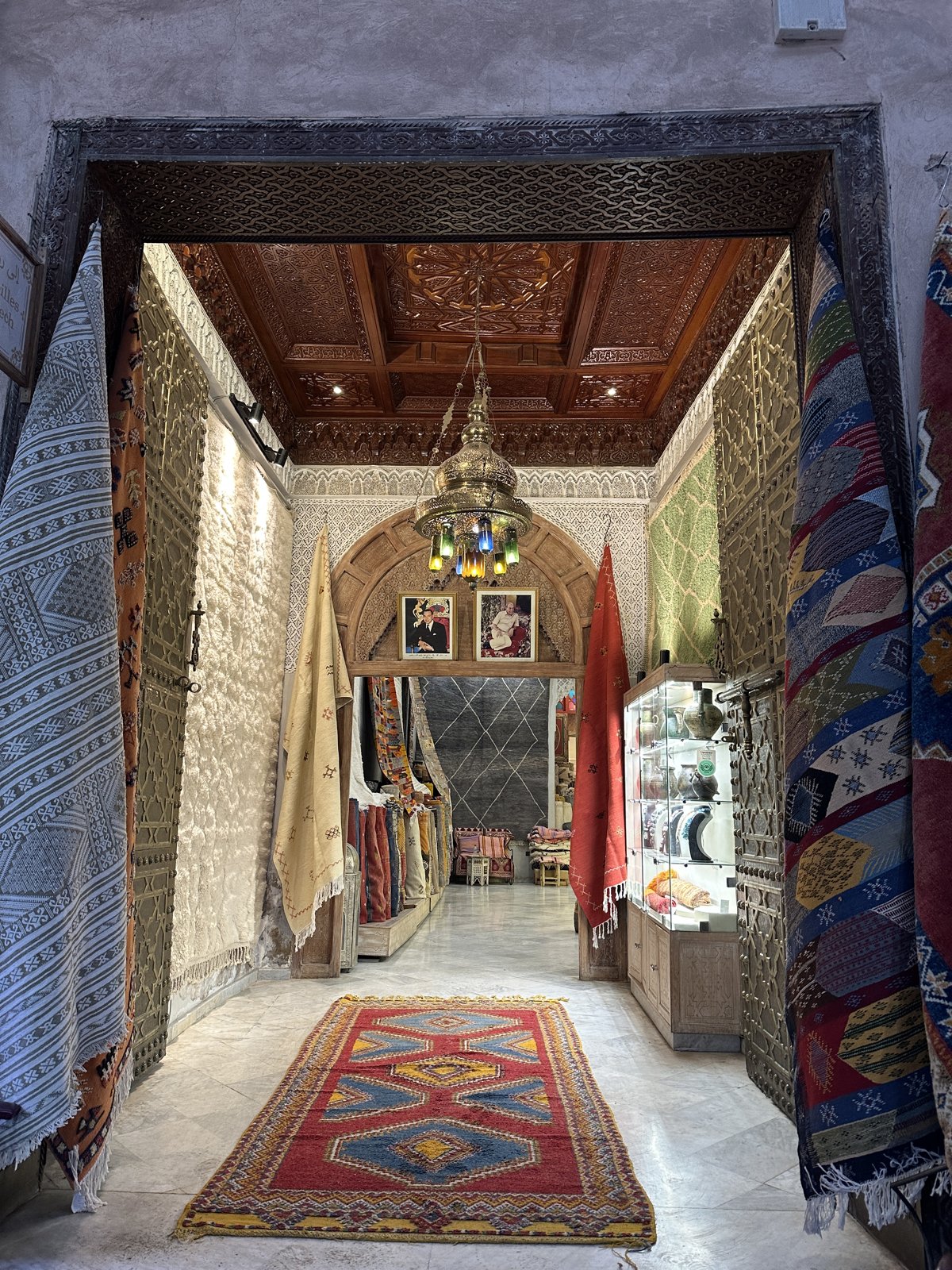
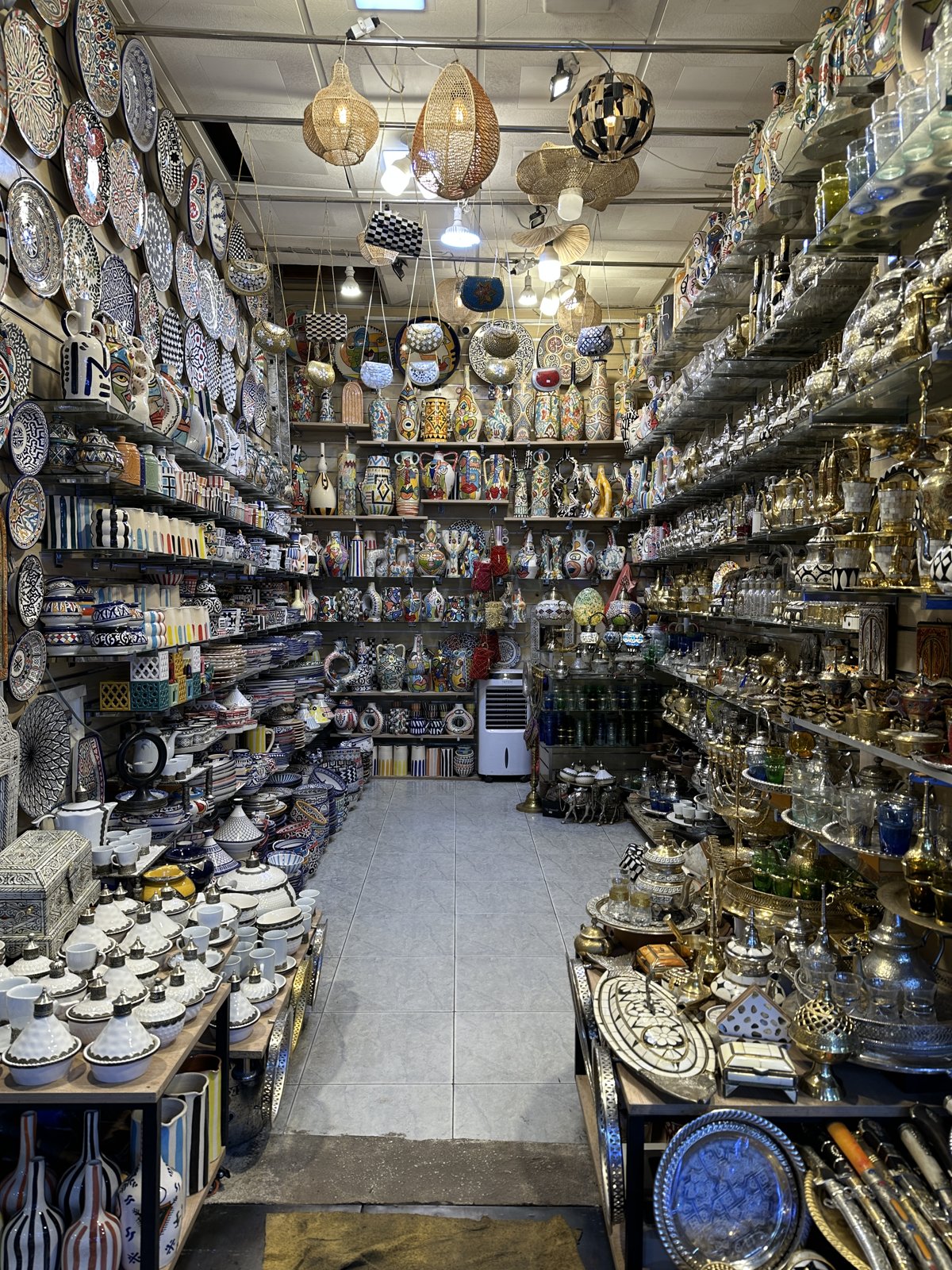
Our tip for the souks is the same as for Fes: go in the morning, when it is calmer, and do not be afraid to walk away from a price. And save some suitcase space for the last day, because you will need it.
How we got around
We booked a seven-seater with a driver through Finest Morocco Tours, and we would highly recommend them. With four of us and this much ground to cover, having a driver made the whole trip possible. Nobody had to navigate the medina approaches or the mountain roads, the long days in the car were actually restful, and we could just look out of the window, which on this route is half the point.
Practical summary
When we went: 20 December to the end of the month, with the last two days in Marrakech. Days were mostly clear and pleasant, but the desert nights are cold, and the High Atlas had snow. Pack layers and a proper warm jacket.
The route: Casablanca, Chefchaouen, Fes, over the Middle Atlas to Merzouga, then west to Aït Benhaddou and Ouarzazate, and over the Tizi n’Tichka to Marrakech. It is a loop with a lot of driving, and several days are mostly spent on the road.
Getting around: a seven-seater with a driver from Finest Morocco Tours. Highly recommended.
Fes: a local guide for your first walk into the medina is worth it.
Chefchaouen: go out early in the morning, before the day-trippers.
The Sahara: Merzouga is the base for Erg Chebbi. Give it at least two nights, and make one of them a night in a desert camp in the dunes.
The macaques: lovely to see, but please do not feed them.
Tizi n’Tichka: check for snow in winter before driving over.
Four of us, three mountain ranges, one desert, and Christmas on a sand dune. Morocco does not do one thing well, it does about six, and it changes from one to the next faster than anywhere else we have been.


Leave a Reply